An interview with Finance and Investment Committee Chair John Webster
Following Governing Body approval of a new Green Templeton College Investment Policy, we sat down with Finance and Investment Committee Chair and Barclay Fellow John Webster to talk about his background, his role, the college’s current position and its future objectives.
Could you start by telling us a bit about yourself?
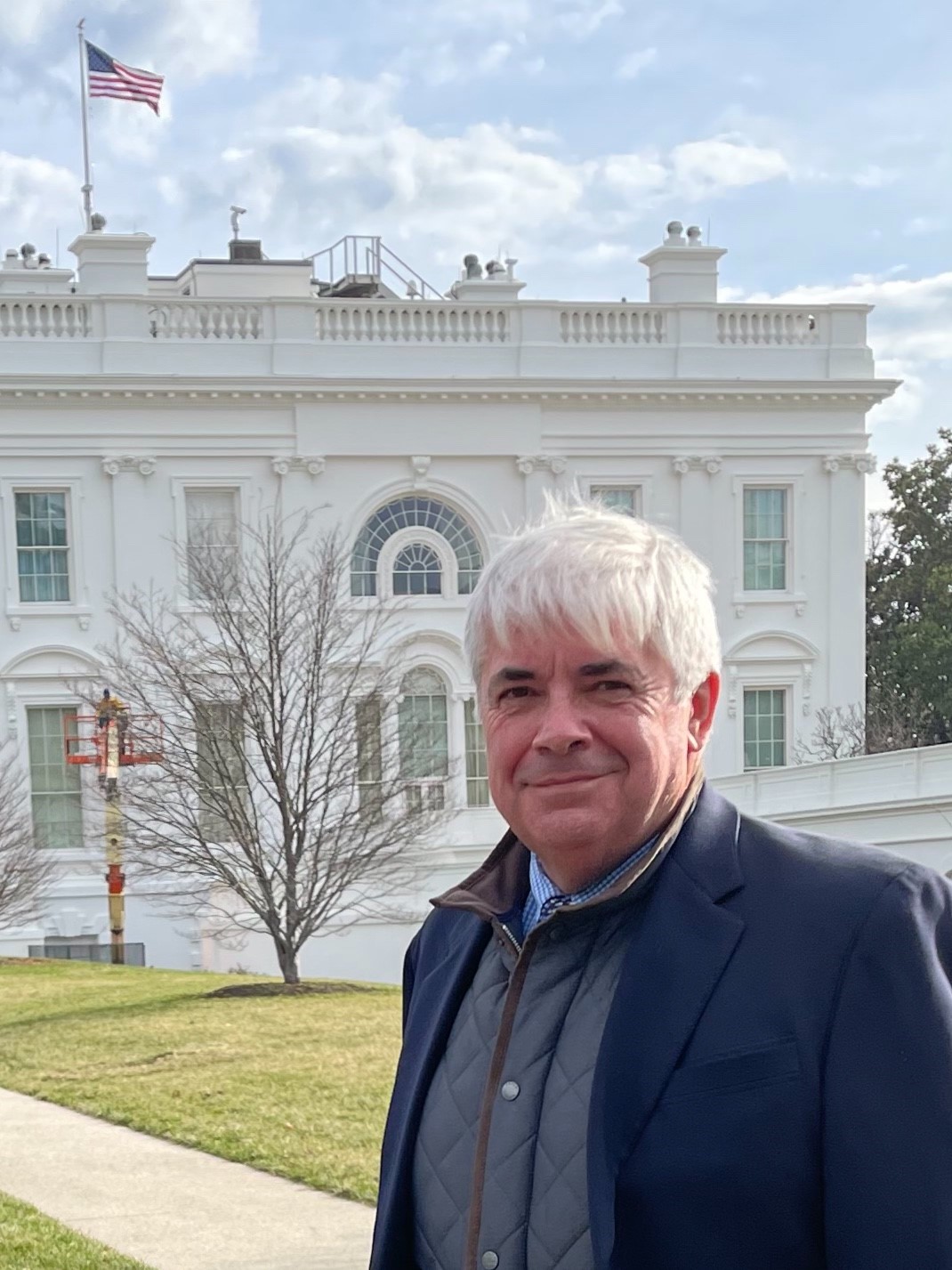
John in Washington, DC in 2020.
I’ve been in the financial services business for almost 40 years – and I spent 20 of those working in the United States. I was sent out to run the New York office of the investment bank I was working for in 1988 at the tender age of 31.
I then moved to a strategy consulting firm in Connecticut, so I spent a lot of time travelling around consulting to investment banks and investment managers in both New York and London – as well as Boston, Baltimore and Edinburgh. I also did some work in Tokyo and Australia, but most of my clients were on the eastern seaboard of the United States and in the UK.
After living in America, I came back to the UK to run an alternative investment management firm as Chief Executive. I’m still its Chairman, although I’m about to retire from that position.
How did you first become involved with then-Templeton College?
Having read Classics at Oriel College, I then did an MPhil in Management Studies at the Oxford Centre for Management Studies (OCMS), which became Templeton College a couple of years after I graduated. I was taught by likes of Michael Earl, Janine Nahapiet , Rosemary Stewart, and Roger Undy – and Uwe Kitzinger was in charge of OCMS at the time.
The centre was an active executive education centre, and therefore, as a for-profit business, it had non-executive directors. Under University of Oxford auspices, it typically graduated about 12 to 15 students with a MPhil in management studies and taught the management section of an undergraduate degree in Engineering, Economics, and Management (EEM). When the centre evolved to become Templeton College it kept these non-executive directors on its Governing Body where they were known as Barclay Fellows – after Sir Clifford Barclay who was one of the founders of OCMS. When Templeton College and Green College merged, the combined entity decided to keep the non-executive Barclay Fellowship as part of the Governing Body of the new entity.
You’ve been a Barclay Fellow of college yourself for the past four and a half years or so – could you tell us a bit about that role and how your election came about?
I moved out of London to a small village north of Woodstock in 2012. Both our children and grandchildren live in America so when I moved back to the Oxford area, I got involved in university things. When I was asked by former Vice Principal and Acting Principal Ingrid Lunt to join the group of Barclay Fellows at Green Templeton I was delighted to accept.
When Ron Emerson my predecessor as chair of Finance and Investment Committee stepped down, I was asked to take the role on given my background in investments.
I’m also currently Chairman of the Oxford University Rugby Football Club (I am a former Rugby Blue).
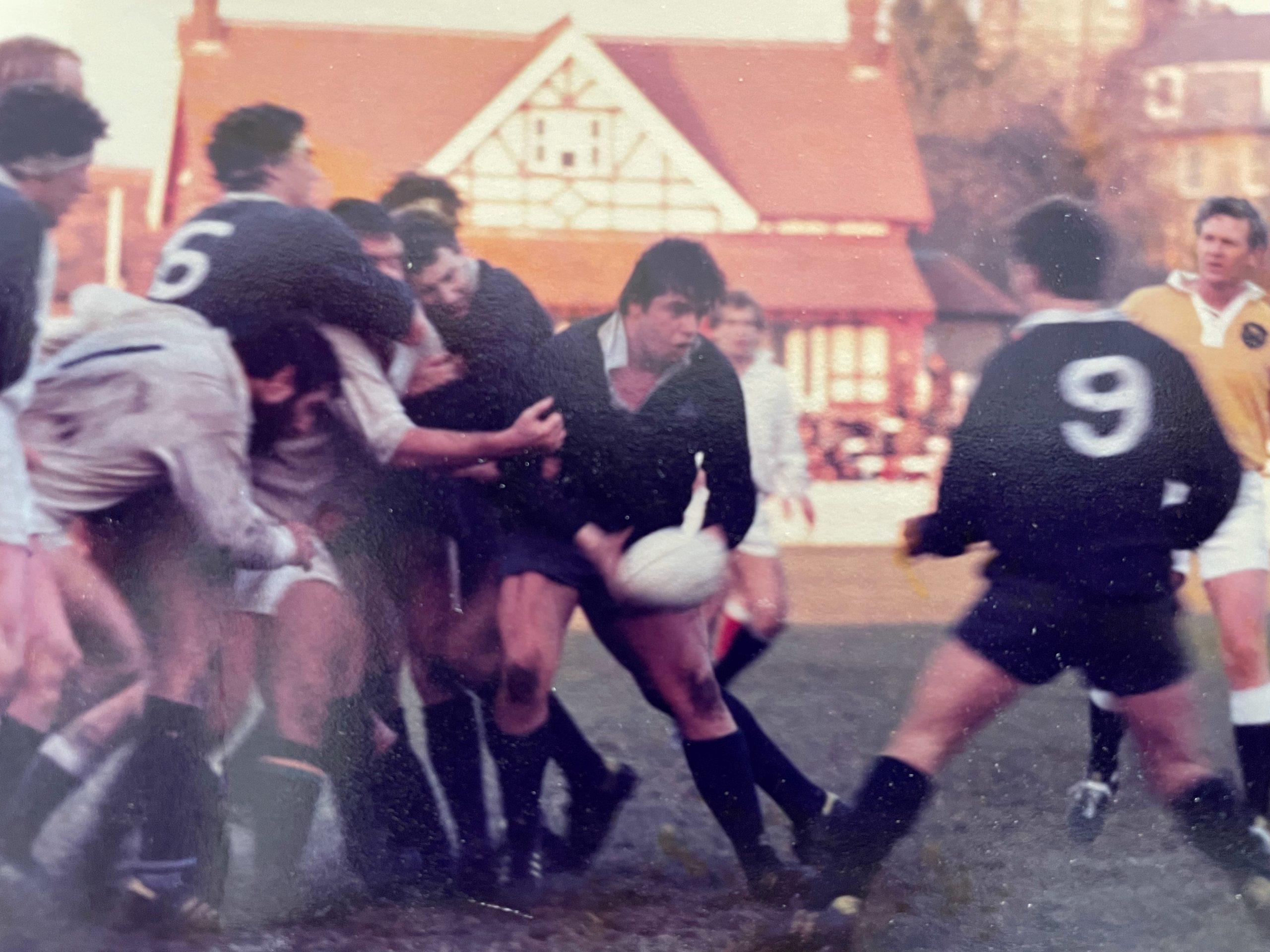
John competing against Major Stanley’s XV in November 1980. ‘A personal favourite as I had just stripped the ball away from an England International.’
How does the Finance and Investment Committee operate?
Green Templeton College is registered as a charity with the UK’s Charity Commission. This requires the Trustees – Governing Body – to behave in certain ways, including 1) managing the charity’s resources responsibly, 2) protecting the reputation of the charity, and 3) being at all times the ‘Guardians of Purpose’ for the charity, by ensuring that all decisions put the needs of the charity’s beneficiaries – college students in our case – first.
Green Templeton’s statutes empower Governing Body to delegate certain of its powers and responsibilities to its committees. In the college’s regulations, the Finance and Investment Committee is one of a number of standing committees. Our job predominantly involves two tasks: with respect to finance, we prepare the annual budget for Governing Body to approve and then monitor and review operational performance against this; with respect to investments, we make recommendations to Governing Body on investment strategy, arrange for the investment of the college’s investment assets in accordance with this strategy, and monitor the performance of these investments.
What are the Finance and Investment Committee’s overarching objectives?
The operating income of the college is supported from the dividends from our investment portfolio. In this context, generational fairness between today’s and tomorrow’s students is very important to us – the expenditure that we are incurring for today’s students must not imperil expenditure on tomorrow’s students. That doesn’t necessarily mean that we must always run at a surplus as there will obviously be periods of capital investment which benefits both today’s and tomorrow’s students. But longer term, we must aim for the appropriate balance.
On investments we believe that as a college we are an institution with expected longevity. I was particularly impressed when in America listening to the then-Chairman of the Yale investment committee, he maintained that the correct investment horizon for their endowment was the next 350 years. Institutions like Oxford colleges need to take a similar view. We want this place to prosper indefinitely and therefore we must think of managing the money that we have in terms of it being permanent capital.
How would you characterise the financial and investment position of the college at this point?
The college’s balance sheet has assets of about £105m, about £65m of which is what I would call operational assets (mostly buildings). Our investment assets total about £40m. Because the merger of Green and Templeton colleges is relatively recent in investment terms, we have an investment portfolio that is still dominated by a series of transactions that took place around the merger. That’s not to say that it’s bad, but if you were starting from scratch you probably wouldn’t design the asset allocation the way it is currently. Of our approximately £40 million of investments, a significant proportion is in a large and well-positioned office building in central Oxford. That’s been an extremely successful investment for the college, and it has been, and is, our only ‘direct’ investment.
The remaining money is invested in a series of managed investments, the largest provider of which is Oxford University Endowment Management (OUem). There we are invested alongside a number of other colleges and the university itself in an investment vehicle that they manage. OUem is a very successful endowment management organisation, run by some very capable people who specifically run money on an endowment basis with a long-term investment view and a well thought through distribution strategy. We also maintain cash reserves to cover commitments for a specific period.
Governing Body has recently agreed a new investment policy, what direction does that set?
It’s worthwhile just saying that as a charity we need to record our investment policy in writing and keep it under regular review. We’ve indeed spent some time recently considering the socially responsible impact of our investing in particular. Governing Body has taken the view that the college’s assets – which includes its investable assets – should be thought of as permanent capital, and should be managed with a view to long term growth to support the college’s activities. Socially responsible investing has at its core a philosophy that seeks to avoid situations that will diminish in value over time. We see that as a fit with our investment mission.
The reason socially responsible investing is important is that if you’re managing permanent capital you want to invest in situations and companies that will survive and create value, not destroy it. If you’re doing socially or ethically or environmentally unacceptable things you’re more likely to destroy value than to create it. That is our broad view.
The dividends and growth of investments will be there to be spent on the beneficiaries, our students, and they are also very keen that we are investing thoughtfully and responsibly, so they can have confidence in the ensuing support for the college’s activities. To that end, there are student representatives on the Finance and Investment Committee and we have spent time with them helping them understand what we are doing with these elements of our investments so that they can be confident if asked that we’re on top of such things and not investing in undesirable situations.
When employing a social or ethical approach, organisations tend to do a combination of things: negatively screen, positively screen and engage with investments and companies in which they are investing. We have done a combination of all three and OUem have done a lot of engagement on these issues with all of their investors and all of the students across the university. So it has made sense not to recreate the wheel, but to piggy back a little bit on their thoughtfulness on this issue.
What are the committee’s targets for the medium- and longer-term?
We don’t set an endowment target return at this point, but clearly an endowment needing to generate more than 4% to cover operating expenditure is overspending. We are in danger of making our endowment work too hard to support the college’s operations and so we’ve been quite keen to ensure that we are making the most of our investments to grow the corpus. This will allow us to build a bigger corpus from which to draw on over time.
I think it is up to us as a college to manage the resources that we currently have to take care of the obligations that currently exist – and that’s been our approach. Obviously if there are donors out there who can help us with that, we would be extraordinarily grateful. Our assessment as a committee in discussion with others in college is that the point of fundraising is for specific tasks – not to bolster what we’ve currently got, but to do new things and/or do better things.
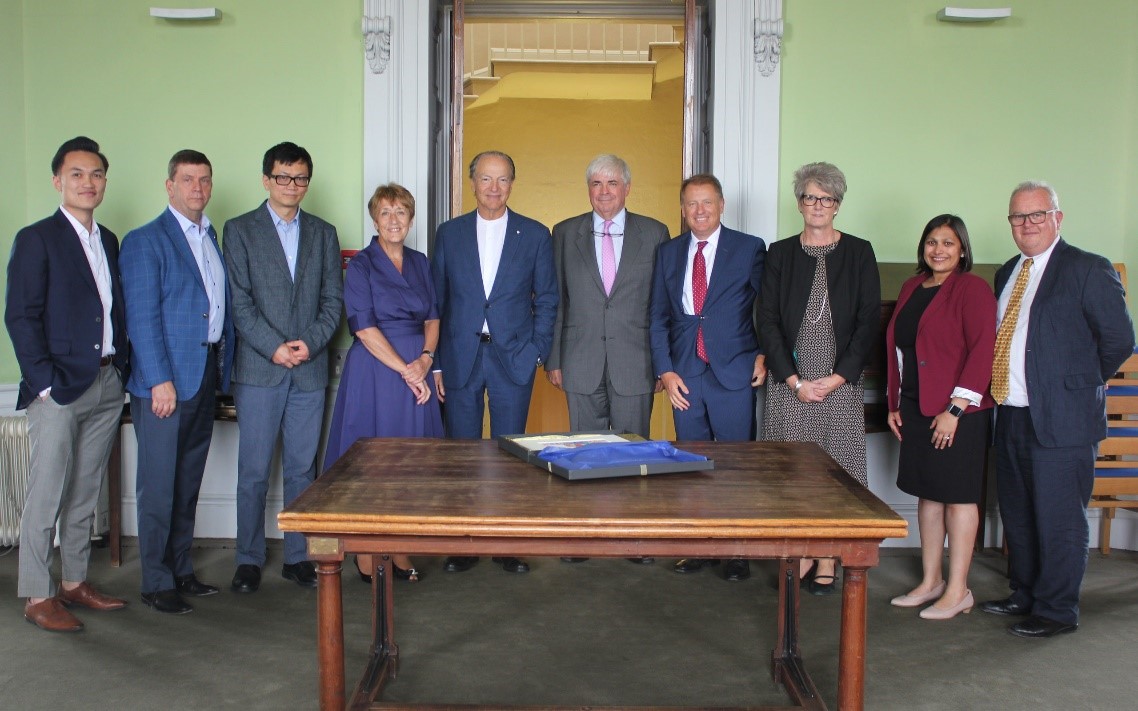
John (right within doorway) pictured as one of the college members hosting guests from the University of Utah in 2019.
How do you think about the future of Green Templeton?
I was humbled to be asked to sit on the committee to find our new Principal, to follow and build upon the contribution of Professor Denise Lievesley when she stepped down. As a non-academic, I’d love to see the shape and the identity of the college evolve and be better understood. And I know that Sir Michael Dixon is spending a lot of time thinking about that, and to help us as a group articulate that.
There seems to be so much that the merger of medicine and management can deliver. Not least in terms of the philosophy of how to run large medical and public health systems, particularly given the pandemic we’ve just been through. How do you afford such things? How can you make them more accessible? These are very large issues we have to deal with. I’m not in favour of one-size-fits-all, because I don’t believe that’s what leads to best outcomes and progress. But I am in favour of learning from the past, and not recreating mistakes in the future. There are avenues for us as an entity within Oxford to work on and create value for humankind. That can be with respect to not just health, but general well-being – be that environmental or be that social. There is a lot of horsepower in Oxford institutions like Green Templeton.
We will want to engage externally to make as practical an impact as possible. In terms of doing new or better things I’ve always been of the view that the three elements of talent, treasure and time are the things that people have to give. I believe we have the talent and with the right will, we can make available the time. What we need is treasure. I’m sure that when people want to give treasure they want it applied to a specific purpose. Our challenge is to be clear about the college’s strategy for the future – and to engage partners and supporters whose purpose aligns with ours.