A new horizon in AI-powered cancer vaccine development
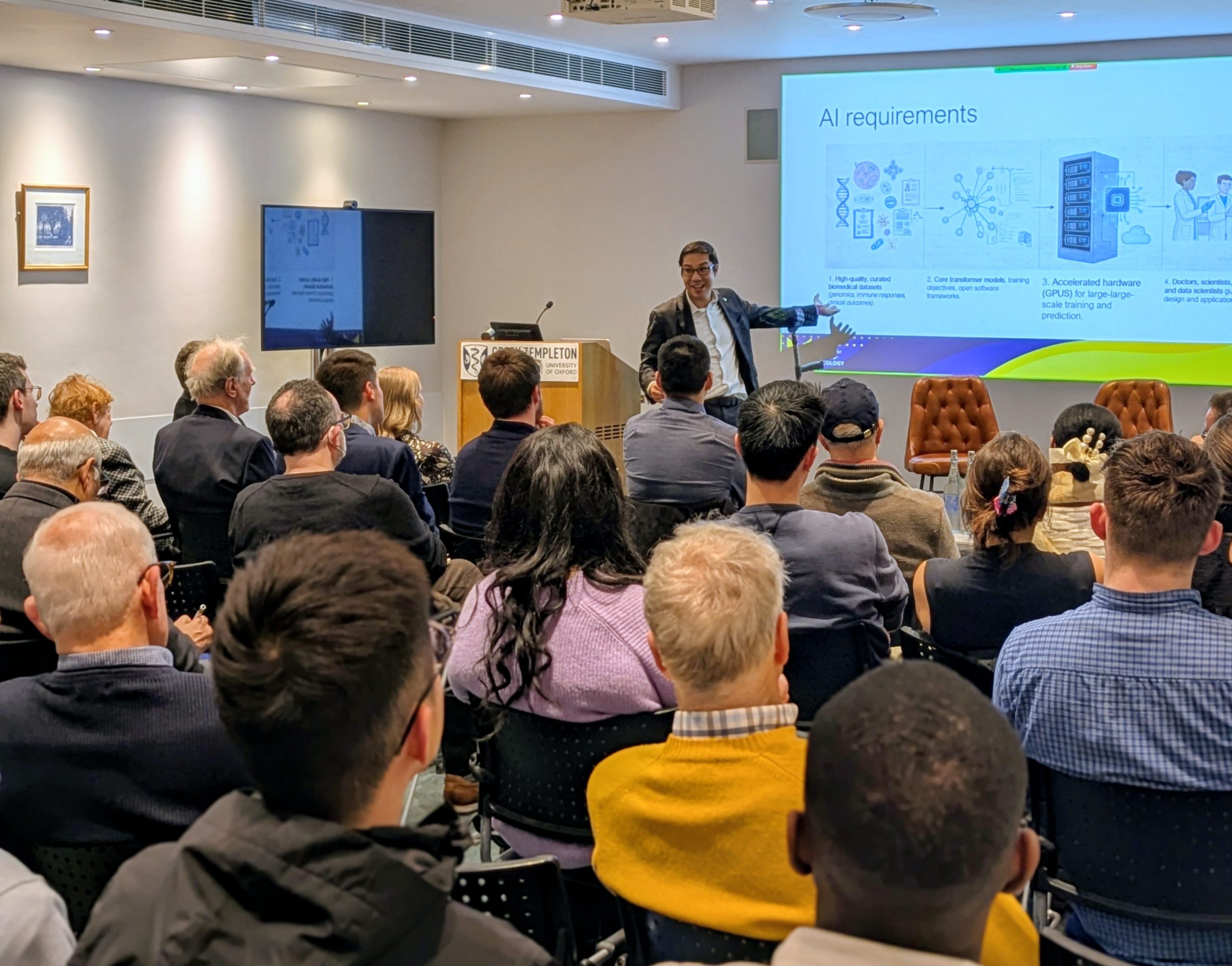
The first lecture of the 2026 Green Templeton Lecture series Innovation and the Future of Health: Find, Fail, Fly was held at the EP Abraham Lecture Theatre on Thursday 12 February. The event was highly anticipated, and brought many students, alumni, researchers, clinicians, and entrepreneurs together.
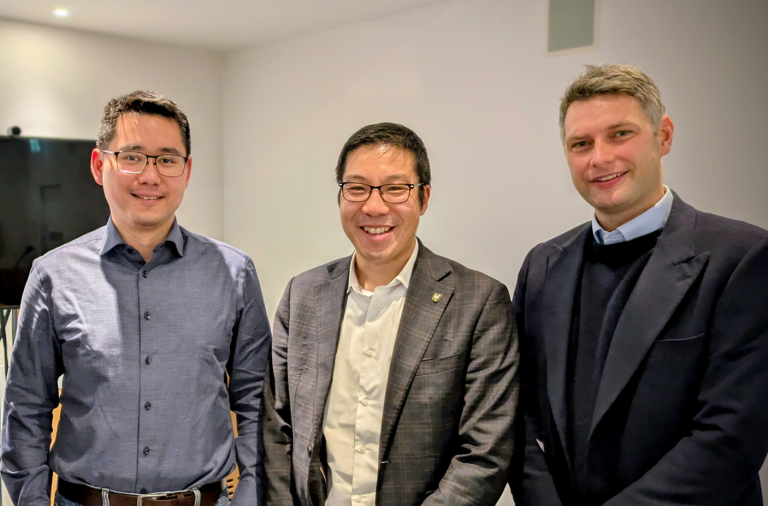
The evening’s lecturers were Lennard Lee (Research Fellow at Green Templeton and Associate Professor at the Nuffield Department of Medicine; Chief Medical Officer of the Clinic at the Ellison Institute of Technology), and Anthony Hsieh (Chief Science Lead of the UK Cancer Vaccine AI Scientist and Supercomputing project).
The audience was warmly greeted by Principal Sir Michael Dixon, and the speakers were introduced by Senior Tutor Alison Stenton. After the talk, discussion was moderated by Christiaan de Koning, chair of the Oxford Health Innovation Forum.
Have we reached a global AI inflection point?
Lennard opened the talk by posing a central question: how can AI technology, which has been rapidly blending into our daily lives, be applied for meaningful public benefit in the UK? Beyond its day-to-day usages, he argued, AI holds transformative potential for improving population health.
In alignment with the UK government’s ambition and commitment to position Britain as the leader in AI supercomputing industries, Lennard and his team seek to open a new horizon of health innovation in Oxford – cancer vaccine development powered by sovereign AI infrastructure.
Cancer immunity: how it works
After Lennard outlined the project’s rationale and ambition, Anthony continued the lecture by navigating the scientific background and details of the technology.
Tumour cells display distinct peptides, known as neoepitopes, on their surface via human leukocyte antigen (HLA) complexes. These peptide-HLA complexes are then recognised by T cells to trigger the body’s defense mechanism. Cancer vaccines introduce peptide-HLA pairs to train the immune system to elicit a stronger and more targeted response against tumour cells bearing those neoepitopes.
Anthony and Lennard’s project employs AI supercomputers and a closed-loop design to rapidly and precisely select the appropriate peptide-HLA pairs. Their model mirrors the structure of generative pre-trained transformers (GPT), such as ChatGPT, and requires a high number of tumour cell genome and health outcomes data for accurate training.
Find out more about this work on AI and cancer vaccines.
Speed is of the essence
Lennard and Anthony emphasised the importance of speed in the development of cancer vaccines. With approximately 120 million peptide-HLA pairs derived from over 12,000 tumours, rapid computational screening is crucial to identify immunogenic neoepitopes and deliver effective cancer vaccine on time.
Anthony drew an analogy between the project and cars: They are building an engine for iterative vaccine design at which AI predicts an immunogenic neoepitope which is tested through automated lab processes on human CD8 T-cells.
Only once the engine is finished and functional can the car begin to accelerate. Situated at the intersection of immunology and advanced supercomputing infrastructure, the project represents an ambitious step toward redefining the speed and precision with which cancer vaccines may be developed in the future. Reflecting the interdisciplinary nature of the project, attendees from various professional, academic, and entrepreneurship backgrounds engaged in the discussion following the talk.
The next session in this series will be a panel discussion with Dr Matthew Frohn, Benny Axt, and Dr Susanna Kislenko. Find out more