From first sparks to first steps
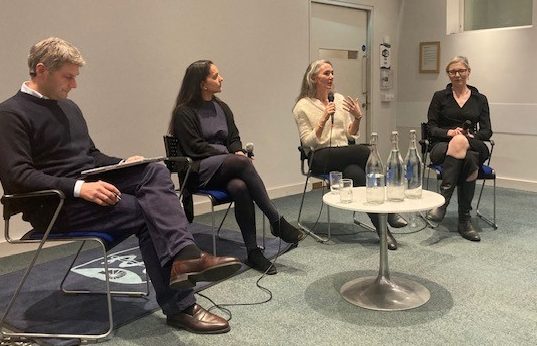
Matilde Girolami (MSc Comparative Social Policy) reports on a panel hosted by the Oxford Health Innovation Forum at Green Templeton.
On 8 December 2025, the Oxford Health Innovation Forum hosted its third talk. Three speakers with very different journeys shared a common desire: entrepreneurship that makes smart things happen, and stays impact-driven.
The conversation tackled everything from imposter syndrome to the ethics of investing, shining a light on what moderator Dr Christiaan de Koning, Associate Fellow of the college, called the human side of investing.
The voices in the room
Dr Danuta Jeziorska
Dr Danuta Jeziorska is a biotech executive. She is the CEO and founder of Uncover Therapeutics, a stealth-mode oncology company, and the scientific founder and former CEO of Nucleome Therapeutics, the Oxford University spin-out using 3D genomics to decode the ‘dark genome’. At Nucleome, she led the 2019 spin-out from the Weatherall Institute of Molecular Medicine, securing £37.5m in Series A funding alone in 2022.
Before stepping into entrepreneurship, Danuta spent almost two decades in gene-regulation research, including eight years at the University of Oxford, and founded Innovation Forum Oxford to help scientists turn ideas into companies.
Esther Richardot Reynal de Saint-Michel
Esther Richardot Reynal de Saint-Michel is the founding general partner of THENA Capital, an early-stage UK medtech fund she co-founded with an all-female GP team. THENA recently announced a first close of £40 million towards a targeted £50 million fund, backing digital health and medtech startups in areas like oncology, chronic conditions, and women’s health.
Before launching THENA, Esther built her career in venture capital and management consulting, developing a deep understanding of healthcare markets and technology trends. Drawn to the fast-paced nature of investing, she ultimately moved from advising companies to partnering with founders, with a focus on improving patient outcomes and closing the funding gap for health innovators.
Dr Emilie Syed is a Senior Investment Manager at Zinc VC. She spent six years at the University of Oxford researching the behaviours underlying addiction before moving into the world of science commercialisation and, eventually, venture capital. At Zinc, she works closely with early-stage teams from inception through to Series A, providing not just capital but also human, social, and intellectual support to help founders turn science into real-world impact.
Key themes
The evening highlighted three recurring questions:
- What makes an idea worth pursuing?
- What role do values play in entrepreneurship and investing?
- What are the different routes to becoming an investor?
What ideas are worth pursuing?
A thread running through the evening was a deceptively simple question: what makes an idea worth backing? Across three very different careers, a shared framework emerged: a good idea sits at the intersection of people, science, the market, and the heart.
- People first
All three speakers came back to the importance of the team throughout the discussion. As Esther Richardot put it, ‘In the end, it’s always about the people’. While plans can be adjusted and ideas can be improved, the team you choose as a founder, or the team you decide to invest in as an investor, is the biggest risk you will have to take in your journey to innovation. Pick wisely. - Innovative Science
Especially in biotech and medtech, the underlying science must be genuinely differentiated. Investors look for platforms and technologies that can go beyond incremental improvements. - An idea with legs in the market
The idea has to be anchored in a real, felt problem. Who is the user? Who is the payer? What incumbent solutions already exist, and why are they not good enough? - Heart (the gut check)
Finally, there is a less tangible but equally important criterion: excitement. The panel was honest that some of their best decisions began with a strong gut feeling that ‘this just matters’. Heart does not act as a substitute for evidence, but it is often what sustains both investors and founders through uncertainty.
Staying true to your own values
Progress gets a lot easier once you are clear on your values. The twist is that ‘staying true’ looks different depending on which side of the table you are on; founders are protecting a mission and building momentum, while investors are maintaining a thesis.
For founders, staying true to your values usually shows up as conviction: a clear sense of what you are building, why it matters, and what you won’t compromise on. The panel offered a simple self-test: ‘If you had to invest your own life savings into this company today, would you?’ If the honest answer is no, it is a signal to revisit the idea, the timing, or your own commitment.
The challenge is that founders often receive conflicting advice. Different investors can push for opposite directions, from a pivot to a sharper focus to a new business model altogether. The panel’s guidance was to treat feedback as data; don’t rebuild after every meeting, instead, look for patterns across repeated conversations.
For investors, staying true to your values looks different. It is less about emotional conviction and more about decision discipline: does this team and thesis fit their mandate and time horizon, and can the founders systematically learn their way forward? In that frame, a ‘no’ is often a ‘not yet’, rather than a verdict on the founder’s worth.
That is why a good ‘investor fit’ matters on both sides of the table: the goal is not to convince everyone, but to find investors whose values, timelines, and expectations genuinely align with the company you are building.
What does the road to becoming an investor look like?
The old stereotype of a single, rigid pathway (investment banking, then VC) is fading. Today’s investors arrive from:
- Academia and translational research
- Management consulting and pharma
- Entrepreneurship and operator roles
If you are considering a move into investing, the panel highlighted three useful ways to get started:
- Build a thesis: What kinds of problems, technologies, or markets do you care about? Why now? Why you?
- Create a (real or hypothetical) portfolio: Start writing short memos about companies you admire. What would you invest in, on what terms, and why?
- Get as close to deals as you can: This could be via angel syndicates, student funds, accelerator programmes, or helping a start-up with fundraising.
The underlying skillset is the same wherever you start: curiosity, pattern recognition, and a willingness to make decisions with incomplete information.
Key takeaways
To pull it all together, here are some of the clearest messages shared in From first sparks to first steps:
- People beat ideas. Investors back teams they believe can learn, adapt, and execute over the long term.
- Great science isn’t enough. Without a real market and a clear route to patients, even the most innovative technology will struggle.
- Listen hard, but don’t contort. Treat investor feedback as useful data points: look for patterns, not isolated opinions.
- There is no single path into VC. Whether you start in a lab, a hospital, a consulting firm, or a start-up, you can build an investing career if you develop your thesis and practise making decisions.
What’s next?
The Oxford Health Innovation Forum will be back on 12 February 2026 with a lecture from Dr Lennard Lee, continuing to build a community bringing healthcare and business together. Join us there!