How to rethink a global economy
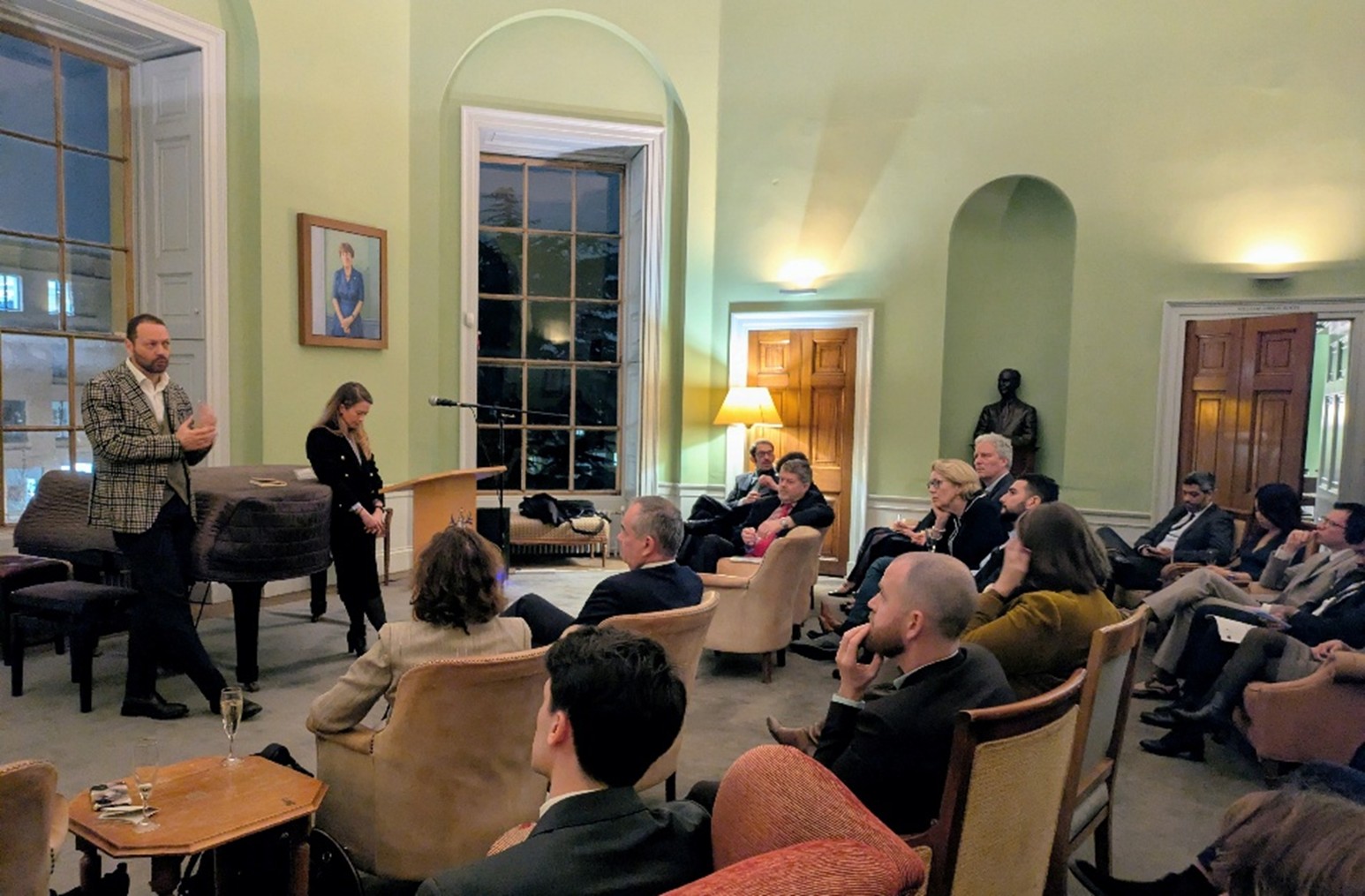
On Thursday 5 February, the Green Templeton Principal’s Circle hosted Massimiano Tellini (Director and Global Head of Circular Economy at the Intesa Sanpaolo Innovation Centre) and Stephanie Walton (DPhil Geography and the Environment, 2023) for dinner at the college. A small group of Green Templeton students were selected to join Max and Stephanie, with other guests from Intesa Sanpaolo, for a private meal in the William Gibson Room, giving them the opportunity for an extended but relaxed conversation with key figures in this field.
Before dinner, Max and Stephanie gave short talks responding to the title ‘How to rethink a global economy’. Max emphasised that replacing the linear economy with a circular model is not just a moral and environmental aim, but should be seen – and increasingly is widely seen – as a sound economic strategy for ensuring geopolitical security, stability and resilience. Recycling is important, but the circular economy is not, as is sometimes thought, just about recycling. Nor is a transition to renewable energy sources enough, however essential this is. Rather, Max called for systemic transformation: we need systems designed to eliminate waste and pollution, to keep materials circulating at their highest value (through reuse, repair, remanufacture and recycling, as well as biological processes like composting), to make possible natural regeneration.
But this is easier said than done, Max acknowledged. As he pointed out, many countries now have circular economy strategies and plans, but struggle to implement them. What is needed, he argued, are approaches which are radical but also pragmatic rather than utopian. Collaboration is crucial: real change is system-level, and so will not come from individual institutions or policies but from sustained public-private action, including financial actors like Intesa Sanpaolo. Finally, Max addressed the young people in the room, advising them to be curious, critical, and ambitious. The future, he concluded, is not a destination but a responsibility.
Stephanie agreed on the need for radical change. Her response drew on her research into stranded assets in the cattle and beef sectors in the USA, and the wider implications of this work for food systems transition. The macroeconomic argument for transitioning to a sustainable economy is clear and widely accepted, she explained, but the real microeconomic changes which are needed are tougher. The markets which created current conditions will not be able to fix them, so we can’t rely on industry-driven or consumer-driven solutions alone. Stephanie’s argument is that a radical shift in economic worldview is needed to make possible the phasedown of the most damaging industries, the reappropriation of illegitimate value, and the creation of markets which are not driven by corrosive forms of competition for index returns, but by public good.
The Principal’s Circle
The annual Principal’s Circle lecture and dinner is made possible through the generosity of members of the Principal’s Circle.
Intesa Sanpaolo partnership
Green Templeton’s long-standing partnership with Intesa Sanpaolo reflects a shared commitment to widening access and advancing responsible leadership. Since 2017, the banking group has supported talented women from around the world to pursue the Oxford MBA at the college. These scholarships cover course fees and provide a living costs grant of over £20,000, enabling recipients to focus fully on their studies and contribute their perspectives to the community.