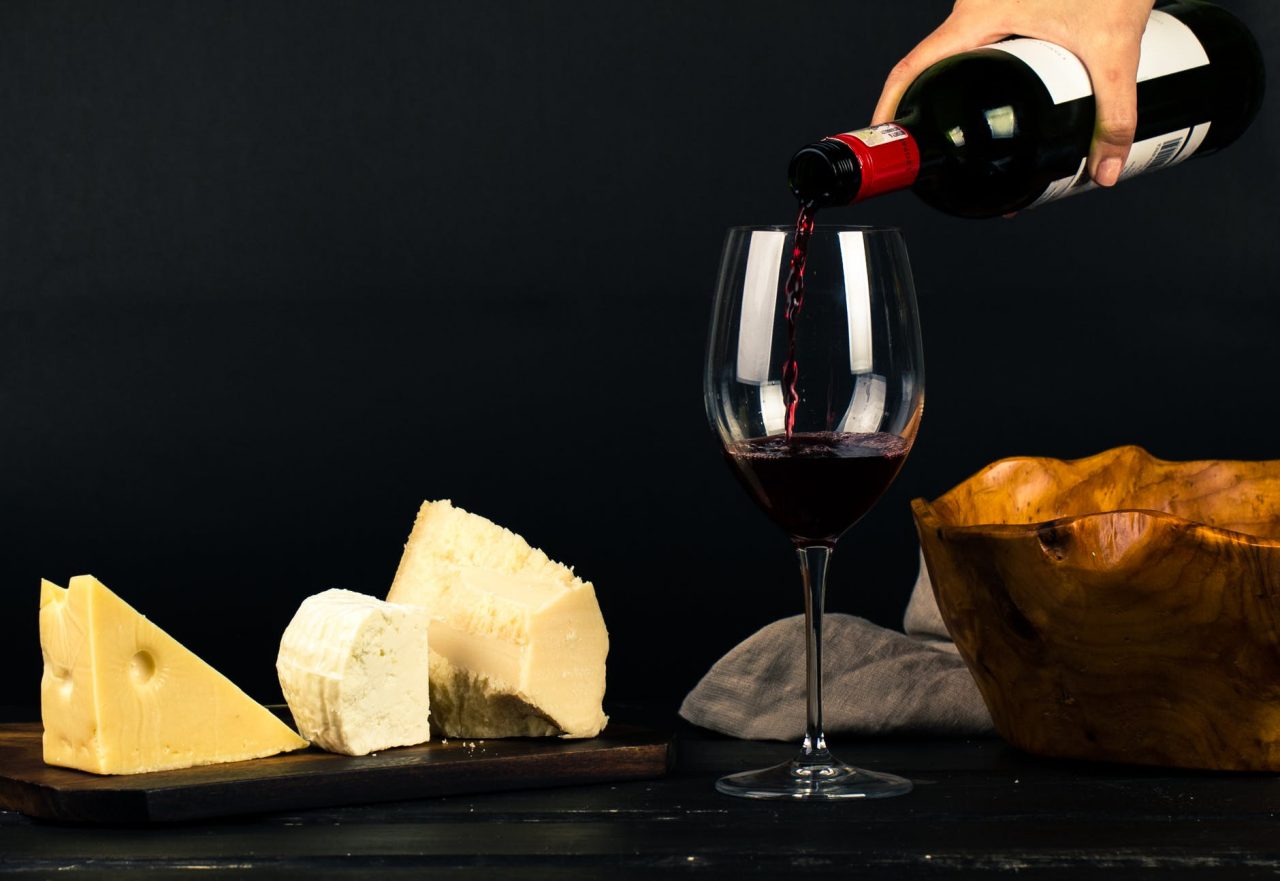
Cheese and wine
Ordered a cheese and wine event kit? Keep reading! On this page is a step by step guide to tasting wines, the tasting notes for the two mini wines, the two household/large order wines, and some generic background about each type of cheese. We also have a full range of vegan wine and vegan cheese options.
Wine tasting
1. Tilt and look
Obviously, you’ll need to pour yourself a glass first for this step to work! You can’t decide if you’ll like a glass of wine by looking at it (well…), but you can start to get an idea of what it’s going to be like.
How deep is the colour? In older red wines, you can expect to see the wine turning an attractive brick red colour at the edges while younger red wines will have a more intense ruby red or purple hue.
Can you see your hand through it or is it like staring into black treacle? That’ll give you an idea of the body and intensity of the wine.
2. Swirl it!
This can take a bit of practice, so don’t do this with red wine anywhere near your housemate’s new white jeans!! By swirling the wine in the glass we’re getting some air into the wine and helping the aroma compounds held within it to escape.
3. Watch the legs
As you swirl the wine in the glass, you’ll start to see what’s known as the legs forming and then falling back down the glass. The more alcohol and/or sugar, the more tightly packed and slower moving the legs will be.
4. Have a sniff
Now it gets fun, so get your nose in the glass and have a sniff. There are absolutely no stupid answers so just say what you smell! The joy of wine is its ability to smell and taste of a million different other things, from fruits to nuts to spices to… forest floor?! Yep, tasting notes can get a bit abstract, but wine can really smell of almost anything.
5. Take a sip
Finally! It’s time for a drink. Take a decent sip of wine and hold it in your mouth, then…
6. Taste it
It might sound obvious, but you’re at a wine tasting, so taste the wine! Try swirling it around your mouth. Look out for the buzzing feeling of acidity in your gums or the furry, grippy sensation of tannin in red wines (or in skin-contact white wines, sometimes called orange wines…).
Is it sweet at all? The different levels of acidity, sweetness and tannin, combined with the wine’s general body contribute to structure and you might start to see a structural pattern in the wines you like.
If you like it highly tannic and acidic, you might favour cassis-scented Cabernet Sauvignons like this wine from Glenelly in Stellenbosch, South Africa, while low acid whites include the floral Viognier and Gewurtztraminer. Cave de Turckheim’s old vine Gewurtz’ is deliciously spicy too. If you’re brave and open to a bit of sweetness and acidity, give ripe German Riesling the recognition it deserves.
7. Slurp it
This also takes a bit of practice. With the wine still in your mouth, try drawing some air in through your lips, without dribbling wine everywhere, preferably. In the same way as swirling the wine in the glass earlier, this will release some of the wine’s aromas compounds. Now that you’re tasting the wine’s aroma and structure at the same time, are you noticing anything different? Sometimes a wine will have a noticeably different character on the nose and on the palate.
8. The finish
Take a moment to judge the wine’s finish. Really good wines will linger on for half an hour or longer after the last taste. And that’s it. Simple really, just take your time to appreciate the wine you’re tasting.
Our wines
Individual bottles
Footsteps Pinot Grigio (contains sulphites, not suitable for vegans)
Made using this popular grape variety sourced from Veneto in northern Italy, Pinot Grigio is the Italian name for Pinot Gris, a white mutation of the Pinot family. It shares its genetic fingerprint with Pinot Noir, Pinot Blanc and several other varieties. The term Pinot Grigio has become strongly associated with light bodied wines produced in great quantities, particularly in northern Italy. The wines are most commonly described as dry white wines with relatively high acidity. These characteristics are complemented by aromas of lemon, lime, green apple and blossoms.
- Colour: Bright, light yellow-green.
- Nose: Fresh, light, apple notes with hints of lemon.
- Mouth: Light, fruity, unoaked wine. Dry but with plenty of green apple fruit and a good mouth-feel.
Footsteps Merlot (contains sulphites, not suitable for vegans)
Footsteps Merlot, made from the Merlot grape which originated in Bordeaux, thrives in the warm, sunny Languedoc-Roussillon region, producing a rich-flavoured, juicy wine with supple tannins. This wine is great with cheeses and Mediterranean dishes.
- Colour: Medium red.
- Nose: Fresh, cherry fruit aromas with chocolate and vanilla.
- Mouth: Medium body, rounded tannins, elegant and juicy fruit flavours of blueberry, cherry and plum.
Chilean Malbec (suitable for vegans)
Malbec is a French variety that was widely planted throughout the Middle Ages in different regions in France, where it was so common that it had over 1,000 synonyms. In its heyday, Malbec was known as the ‘black wine’ of France and favoured by Russian Tsars and French aristocracy. Eleanor of Aquitaine was rumoured to be a fan of Malbec, opting to serve it at her lavish parties.
However, that fame and those vines disappeared. Malbec was problematic. It was too sensitive to the wet and cold weather of much of France’s wine regions. In Bordeaux, where Malbec once had a stronghold, it has almost disappeared entirely. Malbec remains one of the official five red grapes of Bordeaux, but is, in fact, one of the least planted. Along with Carmenère, Malbec makes up less than one per cent of Bordeaux’s red grape vineyards.
If it weren’t for Domingo Faustino Sarmiento or French agronomist Michel Pouget, Malbec’s story may have ended in France. But a new chapter was written as Michel and Sarminento brought Malbec cuttings to the continent, first to Chile and then under the proposal of Argentine governor, Sarmiento, to Argentina. These Malbec cuttings gave seed to the story of Chilean Malbec and of Malbec in Argentina.
Malbec vines have been planted around the port of Concepcion in Chile for centuries and you’ll find very old vines of Malbec in Itata, Maule and Bío Bío in particular. There are also new plantings of Malbec in valleys as diverse as Colchagua, Elquí and Casablanca and Valley Central.
Situated between the impressed Andes mountain range and the Pacific Ocean, the fertile sun drenched Valle Central vineyards create the perfect environment for growing healthy ripe grapes and is where we find the Chilean Malbec you will be tasting today.
- Colour: deep red.
- Nose: ripe plum fruit aromas with hints of cherries.
- Mouth: smooth and rich with ripe fruit flavours of plums, cherries and raspberries, finished with just a hint of violets.
Sauvignon Blanc. W.O Western Cape, South Africa (suitable for vegans)
It is unclear when Sauvignon Blanc was introduced to the Cape, but it was certainly planted at Groot Constantia in the late 1880s and reportedly performed well there. It did not get much attention until almost 100 years later – the first varietal Sauvignon on the market was from a Stellenbosch property, then called Verdun and now Asara, in 1977, with more and more following over the next decade. Interestingly, many of the early examples of Sauvignon were lightly oaked unlike the majority of Sauvignons from the new world produced today.
Such is the fashionableness (and its usefulness in facilitating cash flow) that Sauvignon Blanc is grown just about everywhere in the winelands of South Africa, although Stellenbosch has the majority with 30 per cent of total plantings by area followed by Robertson at 18 per cent.
Its characteristics can vary based on the climate in which it was produced. But generally, it yields a clean quaff, with bright fruit and citrus notes, as well as refreshing acidity. In cool areas, aromas and flavors of green fruits, grass, herbs and bell peppers may prevail, while warm climes tend to result in wines of greater lushness and concentration, with stone and tropical fruit tones. Many Sauvignon Blancs from South Africa combine herbaceous notes and rich fruit.
- Colour: bright yellow with green hues.
- Nose: citrus scents dominate this crisp wine.
- Mouth: crisp and dry wine, packed with mouth watering lemon, lime and grapefruit flavours.
70cl bottles for household or large orders of over four people
Apaltagua Chardonnay 2017 (suitable for vegans)
The grapes are selected from vineyards in the Casablanca Valley. This region is known for the strong Pacific maritime influence and also being recognized as Chile’s first official “cool climate valley,” for the ideal production of white wine grapes. The wine is unoaked and has a brilliant yellow hue with flecks of green. Aromatically, it reveals hints of tropical fruit, such as passion fruit and pineapple. In the mouth it is fresh, with a hint of minerality and a finish that is delicate but elegant, and leaves a persistent note of citrus at the end.
- Colour: Brilliant yellow hue with flecks of green.
- Nose: Hints of tropical fruit such as pineapple and passion fruit.
- Mouth: Fresh, with a hint of minerality and a finish that is delicate but elegant, and leaves a persistent note of citrus at the end.
Cantina Valpantena, ‘Torre del Falasco’ Corvina 2016 (suitable for vegans)
It is the representative wine of Tower of Falasco, a winery located in the region that was known by the ancient Greek civilization as “the Valley of God” (now Valpantena, northeast of Verona) and that, over the years, has become a wine region par excellence. The Corvina grapes used to make Torre del Falasco Corvina 2018 come from vineyards owned by an Italian wine cooperative. There, the fruits absorb the nutrients from very peculiar soils that give them unique characteristics. That is why this wine has an incredible acceptance among experts.
- Colour: Sparkling ruby red.
- Nose: Fresh cherry fruit aromas with hints of wild berries and almond blossom.
- Mouth: Very fruity, medium body, soft tannins, elegant and flattering wine. Perfectly balanced in taste and acidity and convincing with its flowery cherry aroma. The soft approachable tannins give a velvety mouthfeel. Youthful, delicate structure.
Cheese
Brie
Famed for its fluffy white rind and smooth interior, Brie is a genuine delicacy of opulent splendour. Made using milk from either cows or goats, the flavour is soothing, mellow and with a suggestion of nuttiness. Subtle tones of fresh mushrooms and sautéed butter cover its profile, extending into a creamy and smooth finish. A slice of tempered Brie has a soft texture, sometimes slightly runny.
Originally from Seine-et-Marne in northern France, Brie is cherished for its impressionable character, and even graced the tables of royalty in the Middle Ages. Enhancing its surroundings like colour to a painting, Brie is versed as a complement like few other cheeses.
Often compared to Camembert, Brie is milder and with lighter tones of cream and butter, whereas Camembert holds deeper tones of mushrooms and herbs. Both are covered in iconic white mould rinds – completely edible and full of flavour. Complement Brie with walnuts, honey and plum chutney, or melt it in the oven for a rich snack best shared with friends over a glass of wine. Enjoy it at room temperature by removing it from refrigeration at least half an hour before serving.
Stilton
Intricate and rich, the taste of a blue Stilton is one to experience. Slowly opening with creamy and nutty specks, followed by a delicate finish, its body resembles a beautiful mosaic with fine veins stretching like narrow rivers throughout.
The history of Stilton can be traced back to the early 18th century and although it is clear that the recipe used has changed quite dramatically over the years it remains one of the world’s best known and much loved cheeses. Since 1996, Stilton has borne European Protected Designation of Origin (PDO) status. This means that it can only be made in Derbyshire, Nottinghamshire and Leicestershire, and producers have to follow traditional recipes that have been around for generations.
Less moist than other blue mould cheeses, Stilton is strong and intense. Pair with honey, walnuts and sliced apple
Cheddar
Hardly ever in need of introduction, this English treasure has become a permanent resident in global cuisine. During olden days, England was the only place where Cheddar cheeses were made. However, many countries all over the world manufacture Cheddar today. Any cheese producing company or any of the artisan manufacturers in any corner of the world can label the cheese produced by them as ‘Cheddar’ since it is not protected like other cheese names or brands.
Cheddar cheese, the most widely purchased and eaten cheese in the world is always made from cow’s milk. It is a hard and natural cheese that has a slightly crumbly texture if properly cured and if it is too young, the texture is smooth. It gets a sharper taste as it matures, over a period of time between nine to 24 months. Shaped like a drum, 15 inches in diameter, Cheddar cheese is natural rind bound in cloth while its colour generally ranges from white to pale yellow. However, some Cheddars may have a manually added yellow-orange colour.
Joseph Harding, the “father of Cheddar cheese” who invented modern cheese making techniques described the ideal quality of original Somerset Cheddar as “close and firm in texture, mellow in character or quality, rich with a tendency to melt in the mouth and has full and fine flavour somewhat like hazelnut!”
Depending on the age, Cheddar can be found with a diverse range of textures and tastes. Some are even mixed with chilli, black pepper and onion. Pair with a dry red wine, zesty pear and roasted nuts.
Vegan cheese
Applewood Vegan Smoked Cheddar
A solid, classic, mildly yellow block of cheese that has a mixture of smoked paprika on one side, adding that little pazzazz to the smoked cheese. Eaten raw, it tastes so good! It’s delicious and has a woody smoked taste and texture. Applewood use the same smoky flavouring for this cheese that they use for their dairy cheese. The Applewood Smoked Vegan Cheese has the same texture throughout. It is a semi-hard cheese block that is smooth, firm and easy to slice. Its texture makes it easy to slice, cut into small chunks or grated. This cheese is widely toted to be the best vegan cheese available on the commercial market!
Applewood Vegan Mexicana
From the same producer as the famous Applewood Vegan Smoked Cheese comes a new fiery spiced cheese made from a spice mix of real bell and jalapeno peppers. A delicious addition to any dairy-free or vegan cheeseboard but also particularly good melted on pizzas or in toasties!
Ilchester Melting Mature Vegan Cheddar Cheese
A new product in the Ilchester range, styled on the flavours found in original English cheddar, this vegan, soya and gluten-free cheese is gaining momentum in the world of cheese alternatives. Again, this is a great option on a cheeseboard with some ripe pears and chutney but also fabulous on pizzas, jacket potatoes and on top of your pasta bakes!
Ilchester Vegan Blue Cheese with Spirulina Vein
Mild and tangy with blue veins of superfood spirulina, this is a blue cheese for people who aren’t sure if they like blue cheese. More easy going than a traditional Stilton but still very pleasing on the tastebuds and, as a bonus, looks great on a cheeseboard. Also delicious in a pear and walnut salad!
How to order an event kit
Green Templeton students, if you’ve missed the email detailing how to purchase Student Events Kits and would like instructions, please drop us an email on events@gtc.ox.ac.uk and we’ll send you the booking form!
This page has been curated by the Events and Catering teams at Green Templeton. Please contact events@gtc.ox.ac.uk with reactions, comments and suggestions.
This page contains stock photography from Pexels.