Where should the balance of care costs fall?
Green Templeton, Thursday 29 October 2026
Download the slides for this talk (PDF)
A social contract for social care
At this talk at the Green Templeton Care Initiative, Natasha Curry and Camille Oung of the Nuffield Trust outlined the conclusions of their 2026 report for the Nuffield Trust and Joseph Rowntree Foundation, ‘A new contract for social care: how to strike the right balance between state and individual responsibility?’, with a response from Patrick Hall, who is based at the Department of Primary Care Health Sciences at the University of Oxford.
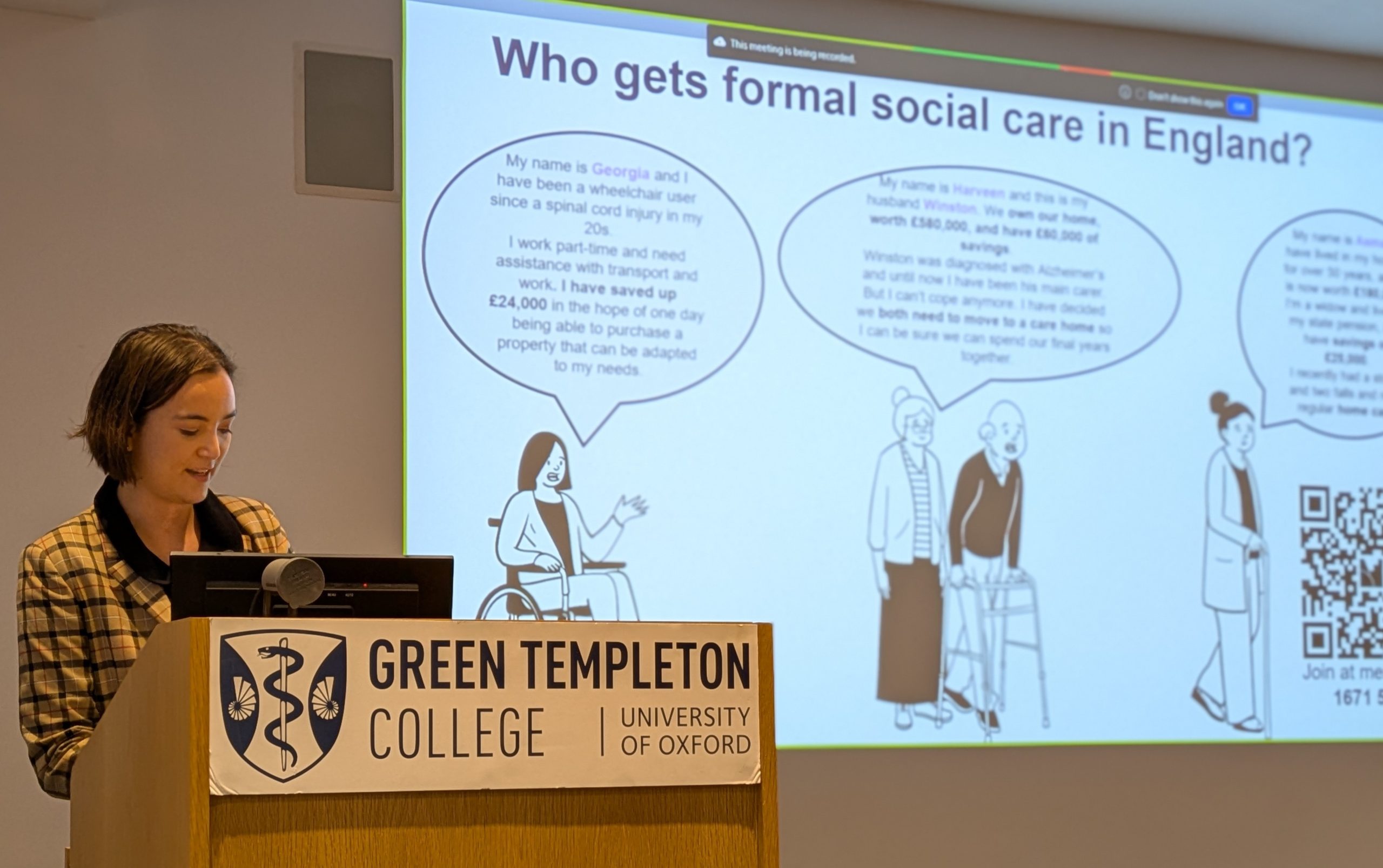
Natasha and Camille began by contextualising the report in what may be a current ‘moment of reckoning’ for social care in England. An audience poll at the opening of the talk focused on three case studies illustrating the nature of the current social care system in England. In this system, almost everyone, including some of the poorest, must contribute to their own care, and that care is very expensive. There is a consensus—among both the audience in the talk, and researchers, practitioners and the public—that this system is unfair and should be reformed.
However, there is as yet no concrete plan for change, and one widely cited reason for the existing impasse has not changed: political and media discussion of social care reform almost invariably starts with the contentious question of who should pay social care costs. Natasha and Camille argued that the conversation needs to start, instead, by establishing a social contract on care. This means a shared understanding of the respective responsibilities of the state, individuals and families or informal carers. If an English social care system which has developed piecemeal, and which is widely thought to be unsatisfactory, is to be replaced with a more deliberately designed, fairer scheme, a foundation of shared, explicit principles is an essential starting point.
The report explores eleven other countries’ and regions’ social systems, providing a ‘whistle-stop tour’ of some of the possible ways of considering the question ‘where should the balance of care costs fall’? Since social care systems tend to be complex, with varying working definitions of ‘care’, drawing meaningful comparisons is far from straightforward. Nevertheless, Natasha and Camille highlighted some immediate conclusions from this research.
First, they emphasised that England is an outlier. In most of the national and regional care systems covered in the report, everyone with care needs is entitled to something, with significant elements varying based on means—and even the means-tested systems tend to be much more generous than in England. At the opposite end of the scale to England is Denmark, which provides all long-term care free of charge to the user. Camille outlined two broad approaches to paying for care among the systems in between:
- Offer the same (or almost the same) to all, e.g. Germany, Scotland. These systems prioritise equality over equity. They often have the advantage of simplicity, providing more transparency and predictability, but can also have inequitable outcomes.
- Vary the offer according to means, e.g. France, where the state may pay for 0-90% of an individual’s care depending on their financial circumstances. These systems prioritise equity over equality. The criteria and processes by which the care offer is varied can be extremely complex, and people may not have an accurate idea of what to expect when they need care.
Without additional checks, both kinds of system (as well as the English system) risk exposing individuals to very high or unlimited costs. Various measures have been introduced by some countries and regions to counter this, in different ways and in relation to different elements of care (for example, residential care, homecare). Some systems require individuals to continue contributing to costs as long as they need care; others (such as Australia) have a cap on lifetime care costs (which is also the approach taken by the Dilnot proposals in England). Again, the models and definitions used by these systems are often complicated and difficult for users to understand.
Defining what counts as ‘care’ is also key. In particular, food and accommodation costs are separated from care in most models (although not in England, New Zealand, or British Columbia), to be addressed or regulated with separate measures. This can help to increase transparency and provide extra support.
Natasha and Camille concluded by outlining three starting points for future discussion of this question.
- There is no single right answer: it is not just a question of selecting the ‘best’ system and transplanting it to England.
- Rather, culturally specific values and ideas of family, fairness, and the role of the state must be the foundation of any successful English model. For example, in France, the children of older care users have a mandatory responsibility to provide support to their parents if they can, and their capacity is included in means testing. This responsibility is the result of historically and culturally generated expectations of family, and would not likely work well in England.
- Political and financial factors will also, of course, determine the shape of any future social care system.
Respondent: Patrick Hall
Patrick responded by asking why the English social care system has become such an extreme outlier. He questioned the effectiveness of current technocratic political rhetoric of ‘fixing social care once and for all’—with its unspoken premise that care is simply a single problem to be fixed with enough money, technical solutions or brilliant legislation—as an approach to overcoming the crisis in social care and creating a genuinely sustainable, effective care system. This language, and the imaginary that it creates, he suggested, hide the essential truth that care “is a permanent, living feature of human interdependence that must be iteratively nurtured.” Neither the state nor the market is fundamentally qualified to deliver genuine care. Both have proven inadequate to replace as care providers the informal human relationships and community networks eroded by late-modern society.
Indeed, Patrick predicted, any immediate attempt to fix social care with a ‘Big Bang’ piece of legislation, whatever it is, will be fatally subject to the factors which have condemned previous attempts at care reform to drift and piecemeal reform rather than real change: cost, lack of automatic updating or change to the provision, powerful veto players who can obstruct change in an adversarial political system, complexity and uncertainty, and a lack of capacity to create an agenda. He concluded that a slower, more iterative process of reform is needed. This, focused first on informal care, could produce a more humane and sustainable care ecosystem.
Q&A
In the Q&A which followed, there was a strong consensus on the need to establish a strong foundation of public consensus around underlying principles for any future care system, despite different opinions about what reform should look like and what language is needed to describe it. All speakers and several members of the audience also emphasised the need for joined-up thinking which does not treat social care in isolation from healthcare, welfare, and other aspects of policy. Topics raised by audience members (in the room and online) included:
- The housing crisis and the financialization of housing in England—and the sometimes toxic effect of attitudes to home ownership—as a factor in discussions around paying for care.
- The need for evidence for the relationship between different care systems and the quality of life of care users.
- Taxation and the wider question of collective vs. individual needs and responsibilities.
- The role of privatisation and the market.
- Whether framing the matter in terms of individual or the state misrepresents the challenge in posing a binary opposition—the state and community are all of us.
- The costs and institutional impacts of complex means testing.
- The effect of the simultaneous devolution of political power to local authorities: will this increase local agency or inequality?
Ruth Scobie, Green Templeton College, University of Oxford