Shaping the future of healthcare through technology
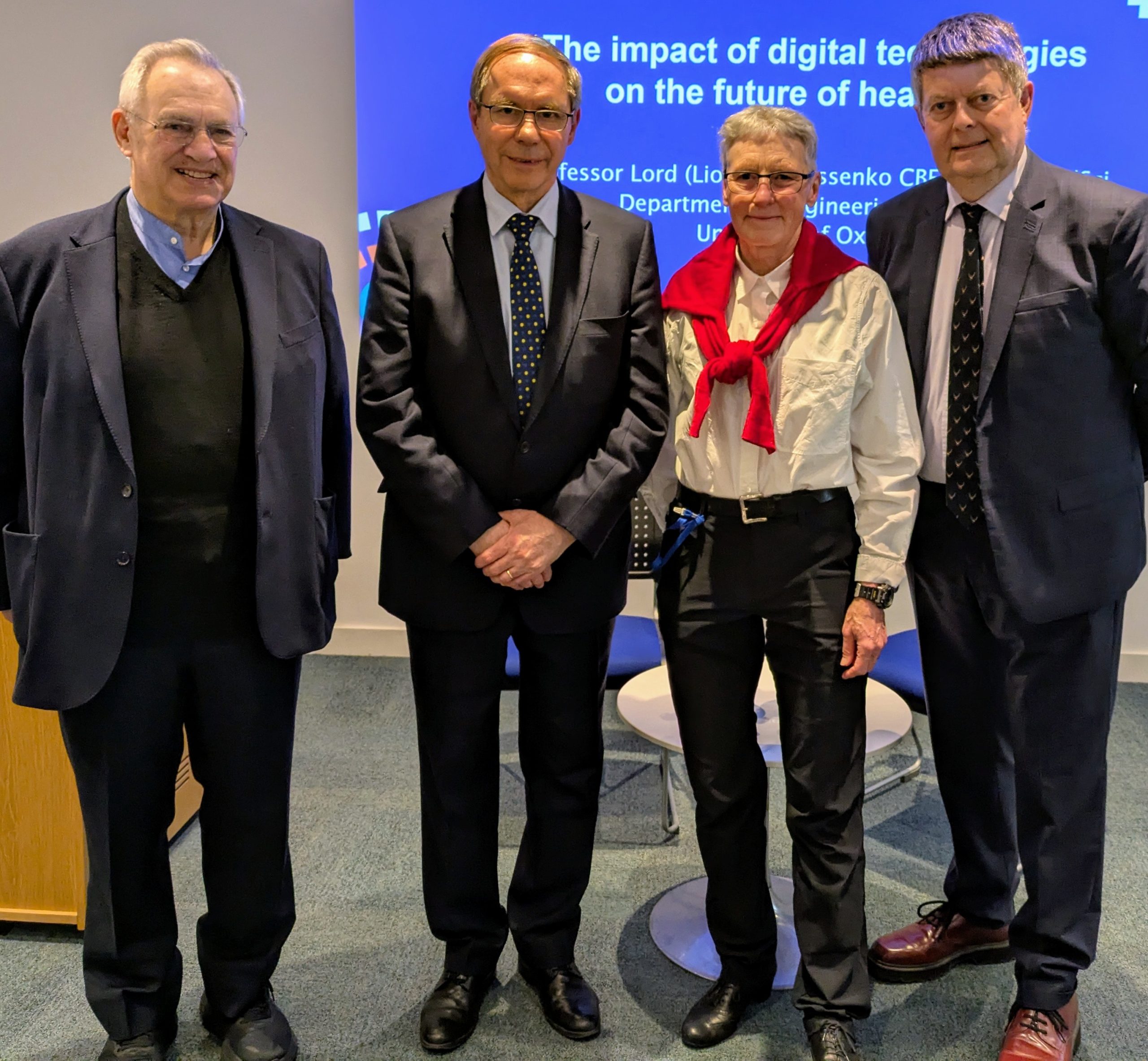
The 2025 Barclay Lecture took place on Thursday 29 May 2025 with generous support from the Barclay family in memory of Clifford and Evelyne Barclay. This lecture series brings leading thinkers to Green Templeton to explore the broader roles and responsibilities of business and management in today’s economy and society.
Sharanya Tripathi (MBA, 2024) reports:
The Barclay Lecture series continues to be a platform for insights at the intersection of innovation, business, and social impact. The recent lecture on ‘The Impact of Digital Technologies on the Future of Healthcare’ was delivered by Professor Lord Lionel Tarassenko. Professor Tarassenko is a world-leading expert in signal processing and machine learning applications in healthcare, with an impressive track record of translating complex technologies into practical clinical solutions. His work has significantly impacted acute care deterioration identification and chronic disease management, establishing him as a pioneer in healthcare technology innovation.
Professor Trish Greenhalgh’s introduction included a compelling anecdote that exemplified Professor Tarassenko’s approach to healthcare technology. During the COVID-19 pandemic, when Oxford hospitals faced a critical shortage of pulse oximeters and were overwhelmed with patients, Professor Tarassenko’s meticulous evaluation of a device sourced from Taiwan, illustrating his engineering precision, collaborative spirit, and deep understanding of technology and human needs. This anecdote perfectly encapsulated how his engineering background combined with human-centered thinking has driven his success in implementing technology in medical settings. It was also a preview of the lecturer’s broader focus on real-world implementation and impact.
Technological Context and Limitations
The lecture focused exclusively on technologies developed within the past twenty years, acknowledging the rapid evolution of smartphones, deep learning, and artificial intelligence (AI) during this period. Professor Tarassenko emphasized the importance of understanding technological limitations, citing companies that falsely claimed their smartphone apps could measure oxygen levels through camera technology—currently an impossible feat.
Professor Tarassenko structured his lecture around case studies, each representing a milestone in the integration of digital technology and AI in clinical medicine.
Gestational Diabetes Management
The first case study examined gestational diabetes, a condition that develops during the second trimester of pregnancy and poses significant risks, including potential transmission to children and preterm delivery. Traditional management required intensive monitoring by diabetes specialist nurses with rapid intervention capabilities, resulting in high resource use.
The technological solution was to develop a mobile application that enabled mothers to self-monitor their condition, with automated alerts to nurses when insulin spikes occurred. This innovation achieved remarkable results: reduced clinic visits, eliminated paper-based systems, decreased medication requirements, and significantly increased overall efficiency. The success established that patient empowerment through technology could simultaneously improve care quality and reduce the healthcare system burden.
Chronic Condition Self-Management
The second case study outlined applications for chronic condition self-management using tablet-based vital sign monitoring and respiratory status assessment. The hardware requirements were deliberately simple: tablets, SIM cards, and Bluetooth connectivity. Recognizing that patients over 75 years old were uncomfortable with keyboards but familiar with ATM interfaces, the team designed an icon-based user experience that leveraged existing user familiarity.
The software incorporated sophisticated features including probe placement detection and machine learning capabilities for vital sign data collection and patient diary maintenance. The system developed personalized alert thresholds for each patient, acknowledging individual variations in health parameters. This approach achieved an impressive 85% patient adherence rate, demonstrating the effectiveness of patient-centered design in creating sustainable healthcare solutions.
Virtual Wards and NHS Bed Crisis
The third case study was on the implementation of virtual wards to address the NHS bed crisis. Traditional hospital monitoring required hourly observations for critical patients. The introduction of wearable devices and remote monitoring systems reduced this to two-hourly intervals while maintaining care quality.
This technology proved valuable during COVID-19, when patient isolation requirements and nurse safety protocols created significant time burdens. Remote monitoring enabled ‘hospital at home’ models, offering flexible combinations of active and passive monitoring based on disease acuity, and providing tailored care approaches.
Second-Generation Machine Learning in Healthcare
Finally, Professor Tarassenko turned to advanced AI applications in healthcare, examining the evolution of artificial intelligence, training methodologies, and large language models.
AI implementation focuses on augmentation rather than replacement. For example, mammogram analysis traditionally required two expert radiologists for comparison, but now uses AI plus one expert, with a second expert consulted only when opinions differ. AI also enables automatic transcription of doctor’s notes into simple English for patients, potentially transforming doctors into health coaches while automating primary care tasks.
Critically, AI suggestions support, rather than replace, physician decision-making. The accuracy differential between doctors using AI (95%) versus patients using AI directly (65%) illustrates why professional medical judgment remains essential—AI cannot independently filter irrelevant information or contextualize findings appropriately.
Looking ahead, Professor Tarassenko is optimistic about multimodal LLMs, which can analyze large volumes of structured and unstructured data, including images, lab results, doctors’ notes and long-term patient outcomes. He believes that new insights and patterns will emerge, further advancing personalized medicine.
Key takeaways from the session:
- The importance of a deep understanding of patient needs
- Leveraging existing, accessible technologies
- Designing within established healthcare pathways rather than disrupting established workflows.
- The integration of behavioral science understanding for patients and healthcare professionals significantly increases adoption likelihood.
- Simplicity and transparency drive adoption.
- The possible impact of technology failures, as demonstrated by Professor’s Tarassenko’s example of a failure to implement novel technologies in hospitals at Belfast.
Conclusion and Reflections
Professor Tarassenko’s lecture was not merely about technology; it was about people. His solutions are characterized by simplicity, user-centric design, and seamless integration into existing medical workflows. Tarassenko’s work shows how engineering guided by empathy and collaboration can genuinely transform lives.