Beyond Gold for sustainability
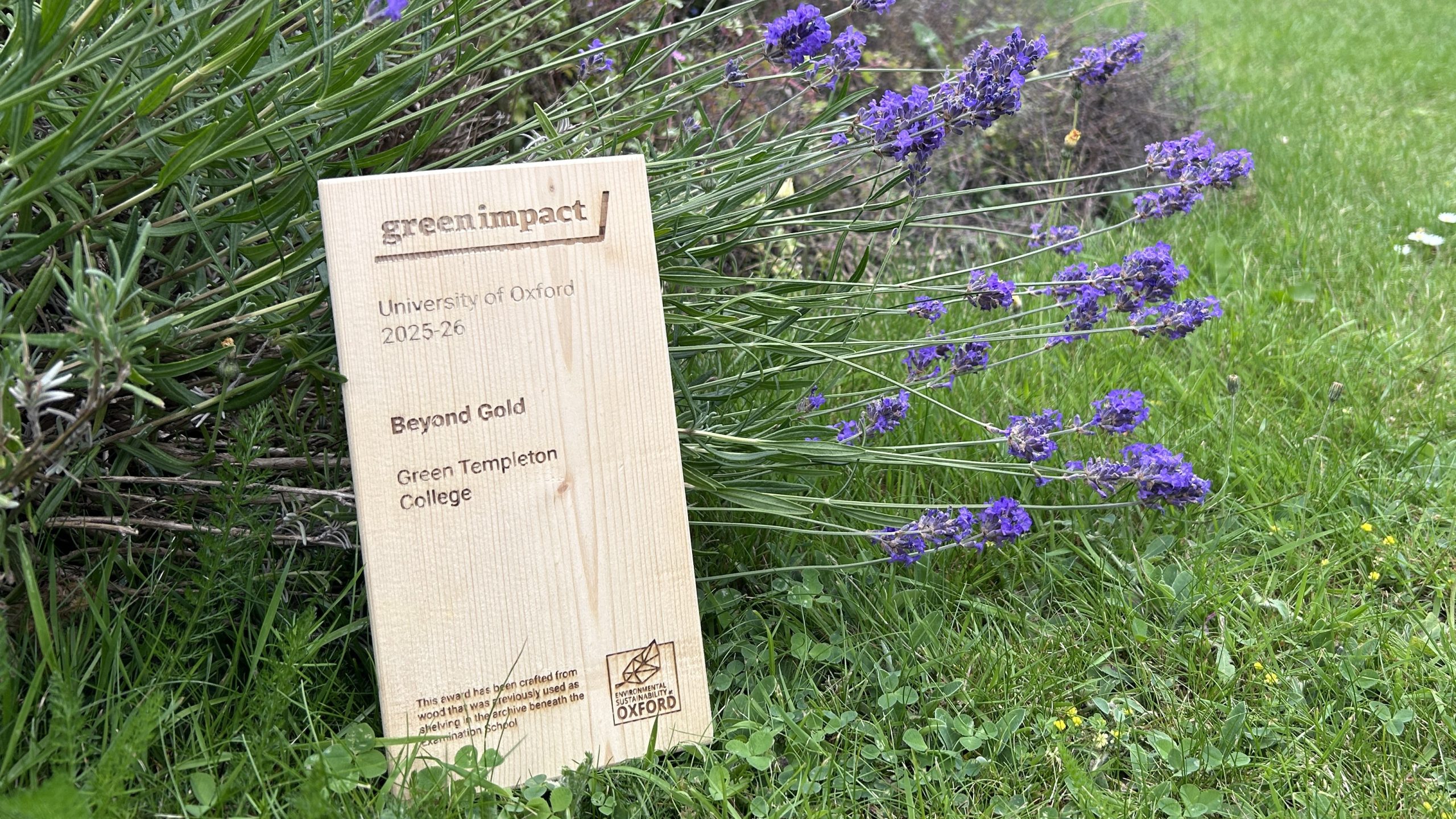
Green Templeton is delighted to announce that it has received a Beyond Gold Award in the Green Impact Awards for the fourth year running.
The award recognises Green Impact actions from previous years that are now well established across the college. These include a refocused Sustainability Working Group with an expanded remit covering decarbonisation, as well as wider social and environmental sustainability.
Sustainability is becoming increasingly integrated into decision-making across Green Templeton. This includes departments such as accommodation, housekeeping and maintenance. Sustainability questions are also now included as standard in a range of job interviews.
Academic and community activities across the college also continue to include a strong sustainability focus. Recent student-led events have included the Justice in the Amazon seminar and Cocoa Conversations. The gardening team continues to work with the kitchen to grow fresh herbs for use in menus on the main site.
This year also saw the launch of a new seed library, encouraging biodiversity while supporting the well-being of college members. Biodegradable seedling pots and peat-free seed compost were provided.
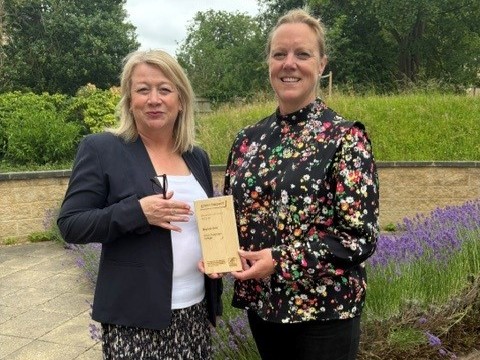
Domestic Bursar Teresa Strike and Operations Manager Elaine Huckson after the Award Ceremony
The kitchen and catering team continue to lead a range of sustainability initiatives. These include taking part in Veganuary, Green Action Week, Earth Day, Vegetarian Day and Fairtrade Fortnight.
Beyond these ongoing and evolving initiatives, the Radcliffe Observatory Conservation Project is now well underway. A significant element of the works involves the repair and restoration of the building’s 62 windows, including the installation, where appropriate, of Histoglass, a specialist thermal glazing product designed for historic buildings. Additional works include repairs to the roof and external doors, all of which will contribute to improving the energy efficiency of this important historic structure.
Perhaps the most substantial sustainability project undertaken by the college this year has been the measurement and analysis of its Scope 1, Scope 2 and Scope 3 carbon emissions.
The college has monitored Scope 1 and Scope 2 emissions for some time, but collecting data on Scope 3 emissions has proved considerably more complex. Early steps included monitoring water consumption and staff travel.
To make this work achievable, the college adopted a tailored methodology, recognising that a single approach would not be suitable for all Scope 3 emissions categories. Where sufficiently accurate operational data was available, this was used. For example, waste emissions calculations were based on recorded waste weights across the majority of waste streams. In other areas, such as catering-related emissions, a spend-based methodology was adopted where supplier and product purchasing data was either unavailable or too complex to interpret.
It was accompanied by a detailed explanation of the methodologies used to calculate each emissions figure. This also identifies areas where assumptions or ambiguities remain, and sets out recommendations for improving future reporting processes.
The Sustainability Working Group is now considering how this data can be used to establish future targets and determine the most effective approach for reporting progress in subsequent years. This will form a key area of focus over the coming year.