Rethinking AI, tech and health equity in medicine
On 15 May, Green Templeton hosted the 2026 Human Welfare Conference, bringing together clinicians, engineers, ethicists and policymakers to ask a hard question: as AI reshapes healthcare, who actually benefits, and who gets left behind?
Conference chair Michael Petrus (DPhil Medical Sciences, 2025) reports
Artificial intelligence is moving fast in medicine, from tools that flag deteriorating patients on a ward to systems that shape national health policy, and the conference’s premise was that this speed makes the equity question more urgent. Rather than treating AI as a purely technical story, the day was built around interdisciplinary exchange across medicine, engineering, ethics, policy and innovation, with the aim of asking what is technically possible, who benefits, who is excluded, and how today’s choices will shape healthcare in the future.
Capabilities
The day opened with a keynote from Professor David Clifton, Chair of Clinical Machine Learning at Oxford. Drawing on his work building machine learning systems for patient monitoring and deterioration prediction, he walked through what it actually takes to get an AI tool out of a research paper and into a hospital ward, from the technical challenges of building models that work reliably on messy real-world patient data, to the practical hurdles of clinical adoption and the global health applications of these systems beyond well-resourced settings. His talk was grounded firmly in what AI can already do today, and where the engineering challenges still lie.
Accountability
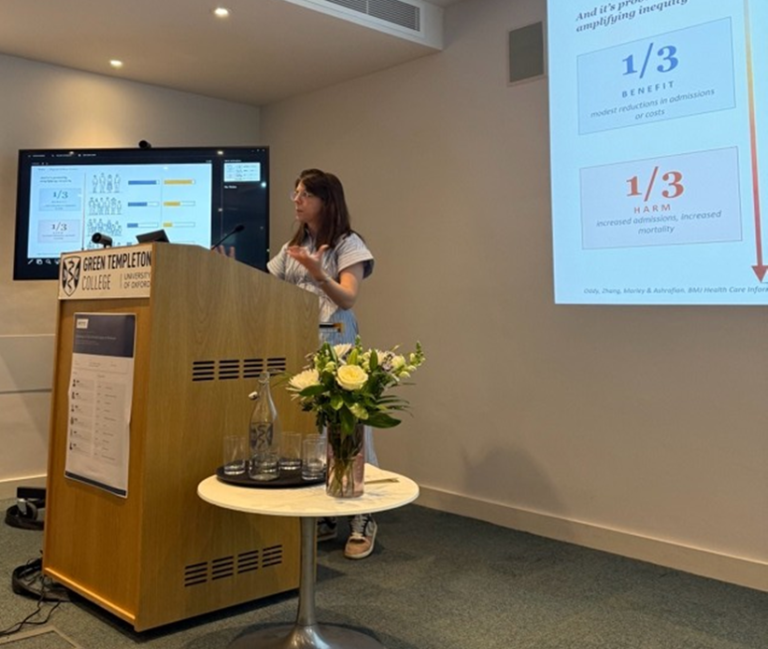
After lunch, Dr Jess Morley of the Yale Digital Ethics Centre offered a different lens on the same territory. Where Professor Clifton’s talk centred on capability, Dr Morley’s pressed on accountability: how data governance decisions made early in a tool’s development shape who it ends up serving, how algorithmic fairness is tested (or isn’t) before deployment, and what happens when AI systems built in one health context are rolled out across very different populations and infrastructures elsewhere. Having both perspectives back to back, one focused on what AI can do clinically and the other on what it should be allowed to do, was one of the best parts of the day, since it meant the conference didn’t settle into a single, comfortable narrative about AI in medicine.
Conversations between perspectives
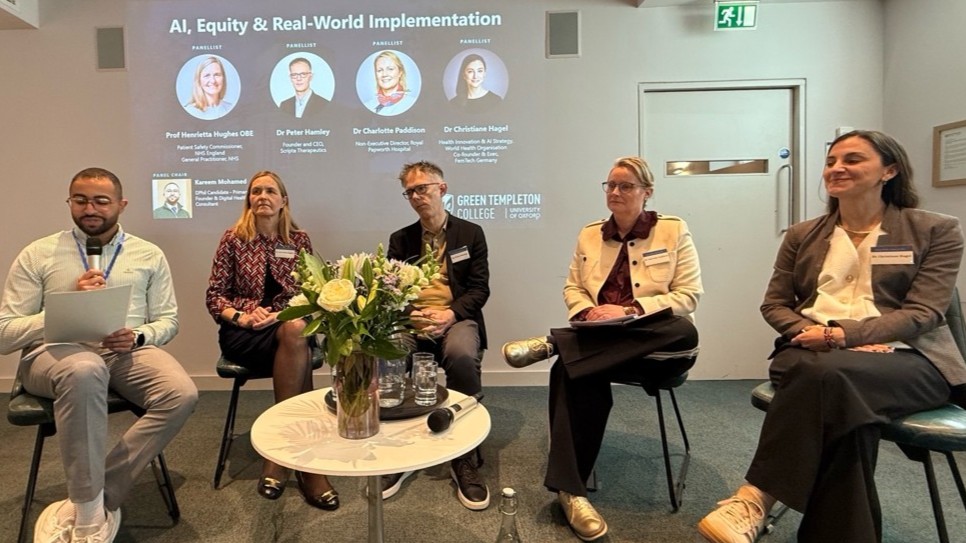
The afternoon panel moderated by Kareem Mohammed, ‘AI, Ethics, Patient Safety & Innovation in Practice,’ picked up directly where the keynotes left off. Dr Henrietta Hughes OBE, the first Patient Safety Commissioner for England, pushed the conversation toward patient-centred governance, asking what it actually takes to embed safety and trust into health systems undergoing rapid technological change. Dr Charlotte Paddison, Non-Executive Director at Royal Papworth Hospital NHS Foundation Trust, spoke from her work on patient experience and primary care, bridging the gap between high-level governance and frontline care. Dr Peter Hamley, Founder & CEO of Scripta Therapeutics, brought the perspective of someone building AI-driven drug discovery tools from the ground up, speaking to the translational pressures and opportunities of running a science-led venture. And Dr Christiane Hagel, Co-Founder of FemTech Germany, brought a global health systems lens, focusing on responsible innovation, data use and equity at population scale. Together, the four offered a panel that moved fluidly between industry, government, hospital governance and policy, and the discussion ranged across where AI genuinely improves patient safety, where it introduces new risks, and how innovation and caution can be balanced in practice.
Alongside the talks, graduate students and early-career researchers presented posters spanning the breadth of health AI research, from maternity care to workforce training to cardiac diagnostics, shortlisted from submissions received ahead. Each presenter had ten minutes to present their work followed by five minutes of questions from an audience that included clinicians, engineers and policymakers alongside fellow students, making for some genuinely sharp exchanges in the poster session. Congratulations to this year’s poster prize winners:
- Pinelopi Stamou – Predicting Induction-to-Delivery Time in NHS Maternity Units Using Interpretable Machine Learning
- Naveed Dogar – From Knowing to Doing: Building an AI-Ready NHS Workforce
- Tariro Banganayi – Decoding Cardiac ‘Languages’ with Advanced Large Language Models
Feedback from attendees was excellent, with many praising the quality and range of the speakers, the pace of the day, and the chance to hear impressive student research.
The conference’s working group has continued meeting beyond the event itself, now developing an academic piece arising from the day’s discussions. The group is being guided by a contact in Dr David Clifton’s lab and by Dr Jess Morley, and the Academic Project Office has also offered its support as the work continues.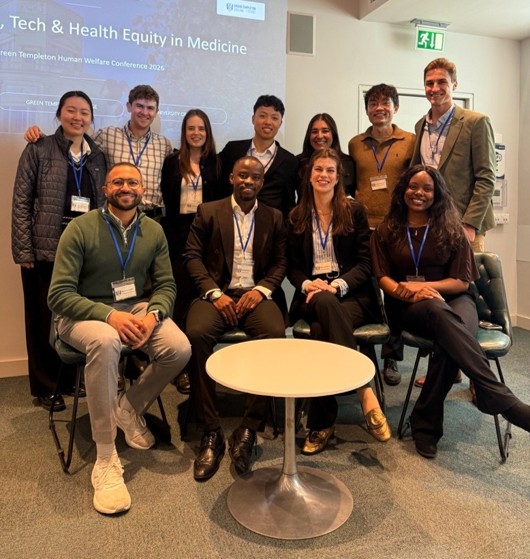
I’d like to thank the organising committee and working group for their tireless effort in planning behind the scenes, and everyone that joined us and presented, helping to make the day what it was, along with the Academic Project Office for their continued support.
Organising Committee
- Chair: Michael Petrus
- Project Manager: Clara Cornelius
- Finance Manager: Kareem Mohammed
- Programme Manager: Tanatswa Nyatanga and Fred Lee
- Speakers Manager: Angus Ong and Christian Cotchobos
- Communications Manager: Bhavya Bhushan
- Working Group: Sofia Germann, Jackson Harrison, and Hannah Lee