What is a good life with dementia?
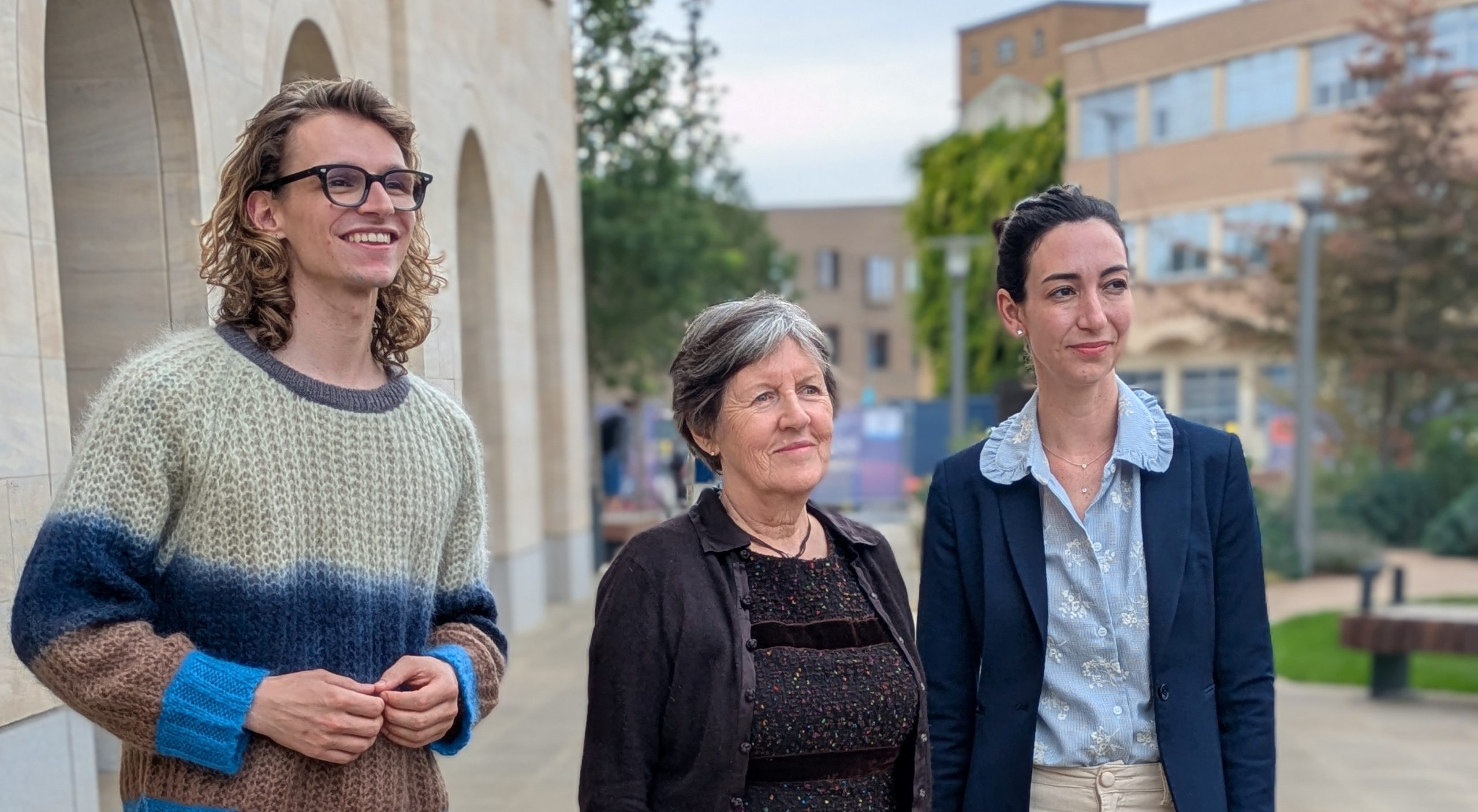
The Green Templeton Care Initiative and the Oxford Institute for Ethics in AI hosted author, dementia advocate and care innovator Teun Toebes at the Schwarzman Centre for the Humanities on 28 September, for a discussion of the experiential work that has informed his bestselling books, The Housemates and Human Forever, and the independent documentary Human Forever. Toebes lived in a closed dementia ward in the Netherlands for three and a half years, and has since travelled widely to gather information about approaches to dementia care around the world, detailed in Human Forever.
Toebes’ talk was preceded by introductory comments from Dr Caroline Green, the Institute’s Director of Research and Head of Public Engagement, and Professor Mary Daly, Professor Emerita of Sociology and Social Policy at the University of Oxford. Green’s introduction highlighted the rapid implementation of AI and other technology as a solution to the problem of ageing populations, emphasising the need for an understanding of the existing systemic context to ensure that existing problems are not intensified.
Daly set the broader context for discussions on dementia care through an account of the current English social care system, and its prospects for major reform. She outlined some of the recent history of social care in the UK as characterised by ‘policy mortality’ in which improvements are proposed and promised but do not survive political changes or controversies about who pays. The current situation is more positive though, with a Prime Minister who has made a public commitment to prioritise social care reform.
England is unusual in Europe in treating social care as a decades-long experiment in marketisation, she explained, and the result is a huge and complex system of mostly private care providers, in which care is increasingly understood as a source of profit without social responsibility, overlapping but not effectively communicating with the health care system. This system is difficult for users and their families to navigate, can be extremely expensive for those who do not meet very strict means criteria, and tends to produce care which is standardised and reactive rather than person-centred and preventive.
Toebes proposed an approach to dementia care which is based on the fundamental question of what it means to be human—a question which, Green noted, is also central to the work of AI ethicists. Seeing dementia as a social issue rather than simply a problem of care provision, Toebes advocates for dementia care which aims to keep people within and connected to society, and which is open to different answers to the question what is a good life with dementia?
Teun Toebes outlined three core principles
A completely safe system does not exist – so open the doors
The dementia care system that Toebes has encountered aims almost exclusively to keep its users constantly happy, entertained and safe. This is evidently well-intentioned. However, Toebes contends, a full, ‘good’ human life does not only include happiness and safety, but encompasses a range of emotions, interactions, risks—and, crucially, the freedom to decide as an individual what combination of these is acceptable or desirable. Dementia care institutions often, and perhaps inevitably, prioritise control and risk management over the autonomy and individuality of their users. Toebes called for a rebalancing of rights and focus, recognising that measures restricting freedom in the name of safety are often counterproductive—he gave the example of rules against users walking outside, which result in risks to both mental and physical health—and that no human being can live entirely insulated from danger, discomfort, or sadness.
Creating a home and belonging
Similarly, Toebes argued, an over-focus on controlling risk is at odds with the needs of people with dementia for an environment which feel like, and really is, their home: this risk aversion results in real houseplants being replaced with plastic ones, Christmases celebrated with fake candles and fake log fires, and standardised pastel colour-schemes based on a homogenous idea of ‘dementia-friendly’ design. Toebes warned against a reliance on copying actions, policies or products from other countries, cultural contexts, and institutions. Each care system needs to be consciously grounded in a culture which supports individual identities and individual ideas of a ‘good life’.
Breaking the stigma
Toebes asked the audience to reflect on their own values, associations and fears in relation to dementia. His experience from inside dementia care systems has shown him that people are critically harmed by the ‘social death’ imposed not by the intrinsic nature of dementia but by social prejudice and medicalisation. He highlighted the ‘tragedy narratives’ promoted by charities claiming to represent people with dementia, both in the UK and the Netherlands, contributing to harmful stigma around the condition in the name of fundraising for research or care. Change, he concluded, requires a collective shift in how we perceive people with dementia, understanding and fully honouring their full humanity.
In the conversation with Green which followed, Toebes resisted the idea of ‘AI’ or even ‘technology’ as a meaningful category of approaches to dementia care. Any ‘solution’, invention, policy or initiative can be positive or harmful, whether it is ‘tech’ or not. What matters is that its implementation is person-centred, within a culture which genuinely supports individual identities and needs. A VR headset could be exciting and liberating for a person with dementia unable to leave their bed, or with an interest in new devices and experiences. On the other hand, a risk-averse institution could also use it as an easy, impoverished substitute for real time outside and real connection to the wider community. Forms of technology which are already circulating widely in society, such as smartphones, have a lot of untapped potential to support people with dementia, Toebes suggested, although they are often overlooked in favour of specialist innovations designed around their medical and care needs and ignoring their status as human and socially-connected individuals.
In conclusion, Daly commented that, in England, the problem with technology in social care is that it is being implemented in a system which lacks the clear values and aims which Toebes had called for. The care field, she said, needs to establish these before it can understand how and where it can be served by tech. She asked Toebes what he thought the care community gathered in the audience should be campaigning for. His response: for a focus on social connections, inclusion, and an understanding of the whole life and community of people with dementia, rather than care needs understood in isolation.